My first time judging a hackathon (on Halloween, in San Francisco)
I spent Halloween at Frontier Tower in San Francisco as a judge at Stranger Builds, NERDCONF's AI hackathon. It was my first time on that side of the table: what I look for in a demo, why scoring is harder than it looks, and what the judge's chair taught me about my own work.

On October 31 I spent Halloween at Frontier Tower in San Francisco, judging Stranger Builds, the Halloween edition of the AI hackathon organized by NERDCONF. It was my first time being a judge at anything.
I have a certificate to prove it. The official judge seal is a rubber duck with its head on fire, which is the most accurate picture of a hackathon I have ever seen.
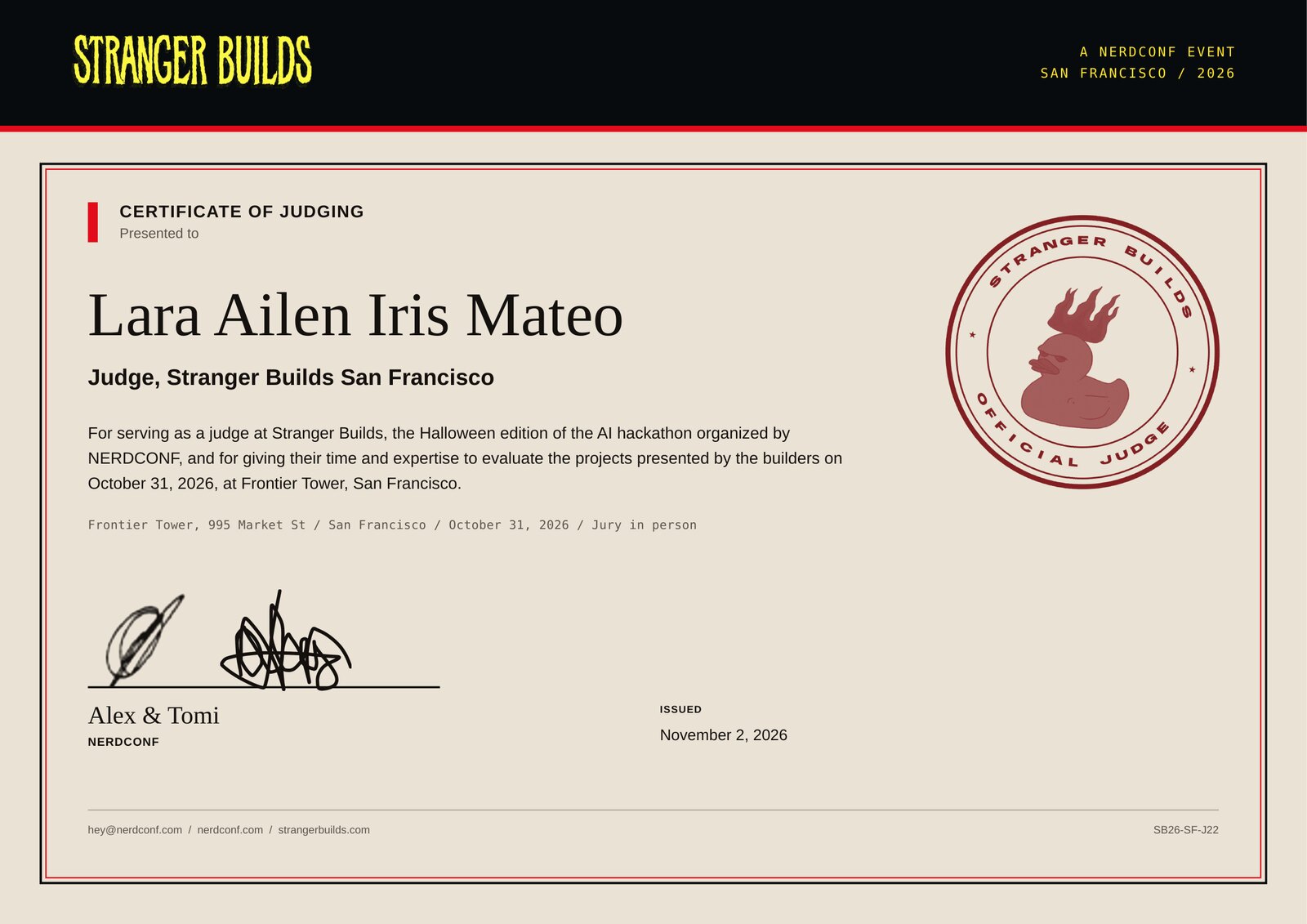
The other side of the table
Until now I had only ever been the person showing the work. I know that seat well. In August I gave a talk where my own demo broke itself live on stage, so I arrived with a lot of sympathy for anyone about to press Enter in front of a jury.
Sitting on the other side is a different job. When you build, the only project in the world is yours. When you judge, you have to hold all of them in your head at once and be fair to each one, including the ones solving problems you had never thought about before that day.
What I look for
I did not want to score on vibes, so I went in with a short list. It is the same list I use for my own projects, which made it easy to remember:
- Does it run? A small thing that works beats a big thing on a slide. A hackathon is the one place where "we only built this one part, but here it is, try it" is the best possible answer.
- Is the AI doing a job? I care a lot about where AI actually helps and where it is decoration. If you could remove the model and the product would be the same, that tells me something. If the model is the reason the thing can exist at all, that tells me something too.
- Can you explain it in plain words? I have written before that the moment you cannot explain a decision simply, you have found the part you do not understand yet. That holds for a pitch as much as for a design doc.
- What did you cut? With a deadline that close, scope is the engineering. Hearing a team say what they chose not to build, and why, tells me more about them than any feature does.
None of these are about polish. Polish is nice, but it mostly measures how much sleep a team gave up.
Scoring is harder than it looks
The part I underestimated is the number. In a code review I have context, history, and time to change my mind. As a judge you get a short demo and then you have to turn it into a score, next to other scores, for projects that have nothing in common with each other.
The last time I graded anyone's work, I was teaching programming fundamentals, and the lesson from back then came with me: the grade is the least useful thing you can give someone. What people can actually use is the sentence next to it. "This part is strong, this is where I got lost, this is what I would try next." So I tried to make sure every score I gave had a sentence I could say out loud to the team.
What I took home
- Judging is a mirror. Every question I asked a team is one I should be asking about my own projects. Does it run, is the AI doing a job, can I explain it, what did I cut.
- Building under a deadline is a skill of its own. It is easy to forget, from the comfort of a normal roadmap, how much gets decided when there is no time to overthink.
- Showing up counts. Putting something unfinished in front of strangers on a holiday, in costume or not, takes more nerve than most of what we do at work.
Thank you
Thank you to Alex and Tomi at NERDCONF for having me and for trusting a first-time judge with a scorecard, and to every builder who showed their work. You made my first time in the judge's chair a very good one.
If you run a hackathon and need a judge who has broken her own demo on stage and will be kind about yours, say hi.